
Alzheimer's & Dementia
Population 60+
1.4B people by 2030
Global Market
$1.7T by 2030
US Seniors 65+
61.2M and growing
Caregiver Value
$413B unpaid dementia care
“NIH-funded insights into Alzheimer’s biology could help with early diagnosis, future clinical trials.”
NIH news release, February 27, 2026The Care Gap
- 70% of adults will need long-term care services at some point in later life.
- $6,200/month is the 2025 national median cost for assisted living, with private nursing home rooms reaching $10,798/month.
- Nearly 12 million Americans provide unpaid dementia care valued at more than $413B annually.
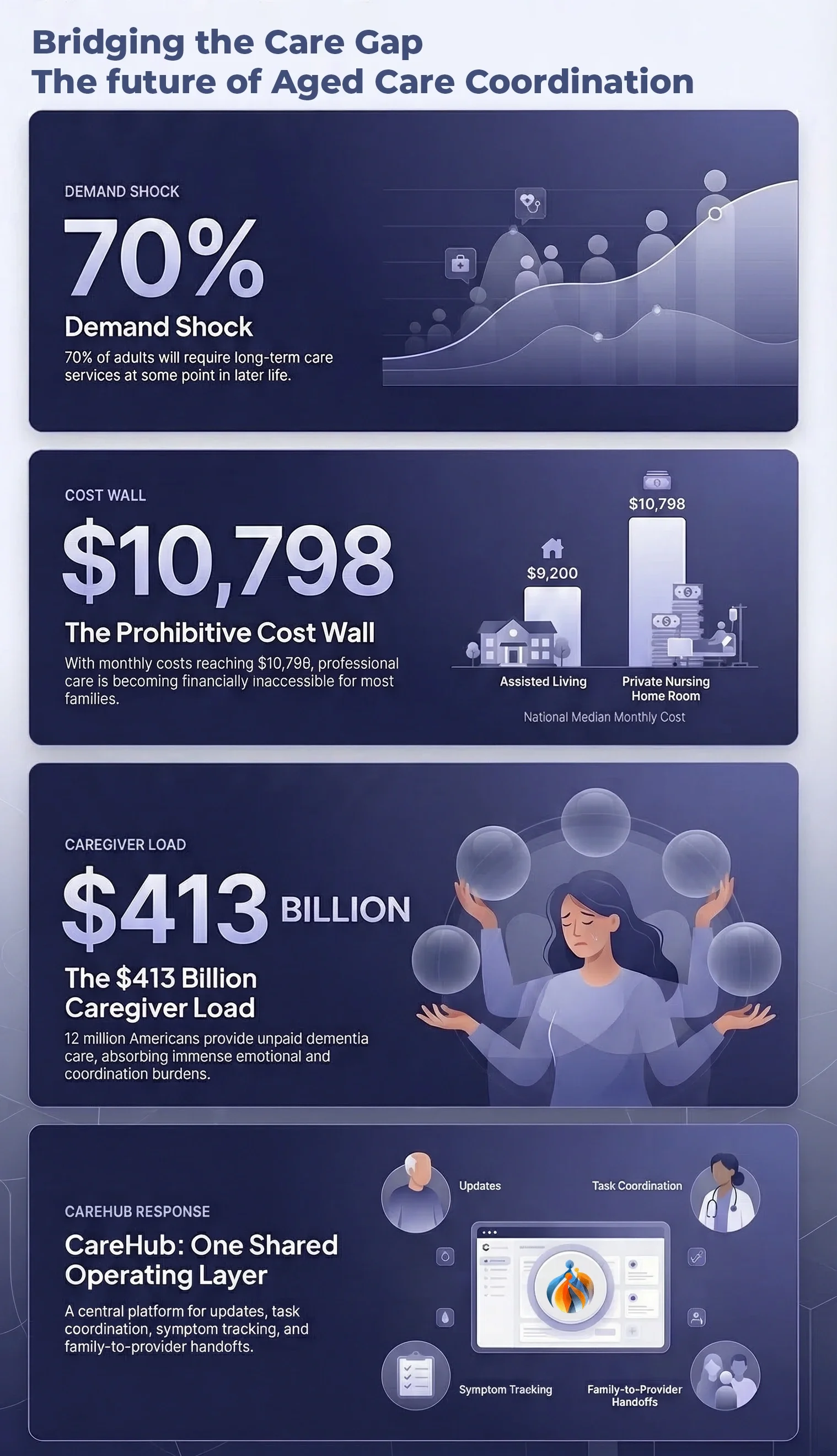
Caregiver Burnout Crisis
Family caregivers juggle medications, appointments, and daily care with no tools to coordinate. Adult children scattered across cities rely on endless phone calls. Medication errors compound. Burnout rates exceed 60%.
The Invisible Decline
Between quarterly physician visits, gradual decline goes unnoticed. Falls happen. UTIs progress to sepsis. Weight loss signals malnutrition. By the time anyone notices, hospitalization is required.
Institutional Documentation Overload
Nursing homes face 450,000+ unfilled positions. CNAs spend 40% of time on paperwork instead of patient care. Family communication is fragmented. Regulatory compliance consumes resources that should go toward care.
CareHub Coordination Layer
CareHub Aged Care module turns fragmented caregiving into one shared operating layer. Unlike self-tracked chronic disease workflows, aged care typically involves multiple contributors around the same person: adult children, spouses, paid aides, visiting nurses, and facility staff. CareHub gives that network one place to log changes, coordinate tasks, spot decline earlier, and reduce the communication gaps that drive burnout, medication errors, and avoidable escalation.
Operational Impact
Earlier intervention when mobility, nutrition, behavior, or daily-function changes start to drift. Lower caregiver strain through shared task ownership and clearer handoffs. Better documentation continuity for facilities and professional staff. Higher engagement because the platform reflects how aged care actually works: as a coordinated network, not a solo patient workflow.
Sources
WHO "Ageing and Health" Fact Sheet (October 2025)
US Census Bureau "Older Adults Outnumber Children" (June 2025)
CareScout Cost of Care Survey (2025)
Alzheimer's Association 2025 Facts and Figures
Caregiver Stability & Therapeutic Response
Coordination is the First Layer
Care coordination solves the administrative chaos around medications, appointments, and handoffs. The next layer is helping caregivers respond earlier when agitation, sleep disruption, burnout, or behavioral escalation begin destabilizing the home environment.
Why Non-Pharmacological Support Matters
Emerging dementia care research points toward lower-risk, non-pharmacological support tools before escalation to higher-burden interventions. Music, reminiscence, calming sensory routines, and immersive VR-style experiences can help reduce environmental stress and create safer moments of connection for patients and caregivers alike.
VR Relevance
VR is compelling because it extends aged-care coordination into response pathways. Instead of stopping at task logging, CareHub can evolve toward guided calming interventions, personalized landmark-based reminiscence, and future caregiver support workflows that help de-escalate agitation while preserving dignity and reducing caregiver strain.
CareHub Opportunities
- Track sleep disruption, behavioral changes, and solo-caregiver overload before crisis points are reached.
- Support future calm-response workflows built around music, reminiscence, and immersive therapeutic content.
- Create one shared log for triggers, interventions, and observed response across family and professional caregivers.
Sources:
Alzheimer's Association 2025 Facts and Figures
Author research synthesis: emerging dementia intervention literature indicates that reminiscence, music, and immersive VR-style calming therapies may support lower-risk non-pharmacological response pathways.
Global Market Analysis
Population Aging: A Global Phenomenon
Population aging is accelerating faster than any previous demographic shift in human history. The WHO reports that between 2015 and 2050, the proportion of the world's population over 60 will nearly double from 12% to 22%.
| Region | Population 60+ (2024) |
Population 60+ (2030) |
% of Total Population |
|---|---|---|---|
| Global | 1.1 billion | 1.4 billion | 17% → 22% |
| United States | 61.2 million (65+) | 73 million (65+) |
18% → 21% |
| Canada | 7.3 million (65+) |
9.4 million (65+) | 19% → 23% |
| United Kingdom | 12.5 million (65+) | 14.2 million (65+) | 19% → 21% |
| Australia | 4.5 million (65+) |
5.8 million (65+) | 17% → 21% |
| Japan | 36 million (65+) |
37 million (65+) |
30% → 31% |
| Germany | 18.5 million (65+) | 21 million (65+) |
22% → 26% |
| China | 280 million (60+) | 370 million (60+) | 20% → 25% |
Market Size by Segment
| Segment | US Market (2024) | Global Market (2024) | CAGR 2024-2030 |
|---|---|---|---|
| Nursing Home Care | $195B | $520B | 5.2% |
| Home Health Care | $142B | $390B | 7.8% |
| Assisted Living | $92B | $215B | 5.5% |
| Adult Day Services | $12B | $28B | 6.1% |
| Hospice Care | $24B | $58B | 8.2% |
| Total | $465B | $1.2T | 6.5% |
Sources:
WHO Ageing and Health Fact Sheet
US Census Bureau Age and Sex Tables
Statistics Canada Population Projections
UK Office for National Statistics Population Projections
Australian Bureau of Statistics Population Projections
IBISWorld Health Care and Social Assistance Reports
Unique Value Proposition: Caregiver-Centric Model
Why Aged Care is Different
Our existing 7 disease modules are primarily patient-centric: the patient tracks their own vitals, symptoms, and medications. Aged Care (our 8th module) flips this model to caregiver-centric: family members, paid aides, and nursing staff track on behalf of patients who often cannot self-report due to cognitive decline, physical limitations, or communication barriers.
The Multiplier Effect
| Factor | Chronic Disease (7 Modules) | Aged Care (8th Module) |
|---|---|---|
| Primary User | Patient (self-tracking) | Caregiver (tracking for patient) |
| Users per Patient | 1.6-3+ depending on condition | 3-5 average |
| Data Points/Day | 5-10 (vitals, symptoms) | 15-30 (ADLs, behaviors, incidents) |
| Revenue per Patient | $3-20/month | $15-50/month |
| Payer Mix | Hospitals, Pharma | Nursing homes, Home care agencies, Families, PACE programs |
Sources:
Alzheimer's Association 2025 Facts and Figures - 7.2M Americans living with Alzheimer's in 2025 and nearly 12M unpaid caregivers, implying an approximately 1.6-1.7 caregiver-per-patient baseline for dementia-heavy cohorts.
Author research synthesis: cancer and dementia caregiving patterns indicate that support networks can expand materially beyond a single caregiver depending on condition severity, family structure, and care setting.
ADL Tracking: The Core Feature Set
Activities of Daily Living (ADLs) are the standard measure of functional status in geriatric care. CareHub's Aged Care module tracks:
- Feeding: Intake percentage, texture modifications, fluid consumption, refusals, assistance level
- Bathing: Frequency, assistance required, skin integrity observations, behavioral responses
- Toileting: Bowel/bladder logs, incontinence episodes, skin breakdown risk, catheter care
- Mobility: Transfer assistance, fall incidents, ambulation distance, wheelchair use, bed positioning
- Dressing: Assistance level, appropriate clothing, grooming status
- Medication: Administration times, refusals, side effects, PRN usage
Behavioral Tracking: Critical for Dementia
For patients with Alzheimer's or other dementias (overlap with our existing module), behavioral tracking is essential:
- Agitation/Aggression: Triggers, duration, interventions that worked
- Wandering: Exit-seeking behavior, elopement risk
- Sundowning: Evening confusion patterns, sleep disruption
- Verbal Behaviors: Repetitive questions, calling out, inappropriate speech
- Mood: Withdrawal, tearfulness, anxiety, apathy
Multi-Caregiver Coordination
The platform enables seamless handoffs between multiple caregivers:
- Family Dashboard: Adult children in different cities see real-time updates
- Shift Notes: Paid aides document care before clocking out
- Care Team Chat: Coordination without endless phone tag
- Incident Alerts: Falls, behavioral episodes, medication errors-immediate notification
- Physician Reports: PDF summaries for quarterly appointments
Phase 1 Markets: Q3 2026
Phase 1: English-Speaking Markets + Mexico (Q3 2027)
Initial rollout focuses on markets with established regulatory frameworks, English-language compatibility (leveraging existing app localization), and strong enterprise healthcare infrastructure.
| Country | Target Segment | Year 1 Partners | Year 1 Patients | Year 1 ARR |
|---|---|---|---|---|
| United States | Nursing homes, Home care agencies | 2-3 regional chains | 15,000-25,000 | $3.6-6M |
| Canada | Long-term care facilities | Sienna Senior Living + 1 other | 5,000-8,000 | $1.2-2M |
| Mexico | Private elder care, Family caregivers | 2 private networks | 8,000-12,000 | $1-1.5M |
| United Kingdom | Care homes, NHS community services | 2-3 care home groups | 10,000-15,000 | $2.4-3.6M |
| Australia | Aged care facilities, Home care packages | 2 aged care providers | 6,000-10,000 | $1.4-2.4M |
| Phase 1 Total | 10-13 partners | 44,000-70,000 | $9.6-15.5M |
Partner Acquisition Strategy
- US: Target regional nursing home chains (50-200 facilities) seeking CMS 5-Star rating improvements. Lead with compliance/documentation value proposition.
- Canada: Provincial health authority partnerships-Ontario and BC prioritized for population density and regulatory environment.
- Mexico: Private elder care networks serving upper-middle-class families + direct-to-family marketing through Spanish-language app.
- UK: Care Quality Commission (CQC) compliance tools + family communication features for care home groups.
- Australia: Aged Care Quality Standards compliance + NDIS-adjacent positioning for home care packages.
Top 3 Target Partners: Phase 1 Rollout
1. Ensign Group (US) - Regional Nursing Home Operator
- Profile: 290+ skilled nursing facilities across 14 states; 32,000+ beds; $3.5B revenue (2024)
- Why Ensign: Decentralized "cluster" model gives individual facility administrators autonomy to pilot new technology-faster decision-making than mega-chains like Genesis or Sabra
- CMS Stars: Strong focus on quality improvement; 65% of facilities rated 4+ stars; actively seeking documentation tools to maintain ratings
- Tech Readiness: Already uses PointClickCare EHR; CareHub integrates via existing APIs; family portal fills gap PCC doesn't address
- Pilot Potential: 5-10 facilities in California or Texas cluster; 1,500-3,000 residents; $450K-900K Year 1 ARR
- Mission: "To dignify long-term care in the eyes of the world."
2. Bupa Aged Care (UK/Australia) - Global Care Home Operator
- Profile: 125 care homes in UK (10,000 beds) + 72 homes in Australia (6,500 beds); part of Bupa Group ($18B global revenue)
- Why Bupa: Cross-border presence enables single partnership to cover 2 Phase 1 markets; strong regulatory compliance culture (CQC in UK, ACQS in Australia)
- Family Focus: Bupa has invested heavily in family engagement-"Bupa Care Services" app exists but lacks clinical depth; CareHub fills feature gap
- Quality Scores: 78% of UK homes rated "Good" or "Outstanding" by CQC; Australia portfolio recently passed Royal Commission scrutiny
- Pilot Potential: 10 homes each in UK and Australia; 2,000 residents; $480K-720K Year 1 ARR
- Mission: "Helping people live longer, healthier, happier lives."
3. Sienna Senior Living (Canada) - Canada's Largest Senior Living Provider
- Profile: 81 seniors' residences across Ontario and BC; 13,000+ beds; C$780M revenue (2024); TSX-listed (SIA)
- Why Sienna: Largest publicly traded senior living company in Canada-covers both long-term care and retirement communities; provincial government relationships for regulatory buy-in
- Quality Focus: Significant investment in quality improvement post-COVID; "Butterfly" dementia care model adoption shows innovation willingness
- Tech Readiness: Active digital transformation initiative; seeking family engagement tools to differentiate from competitors
- Pilot Potential: 10-15 Ontario LTC homes; 2,500-4,000 residents; $600K-960K Year 1 ARR
- Mission: "To help seniors live fully, every day."
Pricing Model: Higher ARPU Than Chronic Disease
- Nursing Homes: $15-30/resident/month (compliance documentation + family portal)
- Home Care Agencies: $10-20/client/month (caregiver coordination + outcomes tracking)
- PACE Programs: $20-50/participant/month (comprehensive tracking for at-risk elderly)
- Direct-to-Family: $5-10/month (remote monitoring, care coordination)
Blended ARPU: $20/patient/month (vs $8/patient/month for chronic disease modules)
Phase 2: Global Expansion 2027-2028
Phase 2 Markets: Europe, Asia-Pacific, Latin America
Following 12-18 months of Phase 1 validation, expand to high-growth aged care markets with localized versions.
2028 Expansion
| Region | Countries | Target Partners | Projected ARR |
|---|---|---|---|
| Western Europe | Germany, France, Netherlands, Spain | 2-3 per country | $8-12M |
| Asia-Pacific | Japan, South Korea, Singapore | 2-3 per country | $6-10M |
| Latin America | Brazil, Argentina, Colombia | 2 per country | $3-5M |
2029 Expansion
| Region | Countries | Target Partners | Projected ARR |
|---|---|---|---|
| Scandinavia | Sweden, Norway, Denmark, Finland | 2 per country | $4-6M |
| Greater China | China (Tier 1 cities), Taiwan, Hong Kong | 3-5 total | $10-20M |
| Middle East | UAE, Saudi Arabia, Israel | 2-3 total | $3-5M |
Regulatory Considerations
- EU: GDPR compliance already built into platform; additional focus on health data sovereignty requirements
- Japan: Long-Term Care Insurance system integration; Japanese language localization critical
- China: Data localization requirements; partnership with local entity essential; focus on private facilities initially
- Middle East: Arabic language support; cultural sensitivity in caregiver gender matching
5-Year Revenue Projection
Aged Care Module Revenue: 2027-2030
| Year | Phase | Countries | Patients (000's) |
ARPU | ARR |
|---|---|---|---|---|---|
| 2027 | 1 Launch (Q3) | 5 | 50 | $20 | $12M |
| 2028 | 1 expansion, 2 Launch | 15 | 200 | $18 | $43M |
| 2029 | 2 Expansion, Global Launch | 25 | 500 | $16 | $96M |
| 2030 | Global at Scale | 35 | 1,200 | $15 | $216M |
Note: ARPU decreases over time due to geographic mix shift toward lower-cost markets. Volume growth more than compensates.
Aged Care Contribution to Total CareHub Revenue
| Year | 7 Disease Modules ARR | Aged Care ARR | Total ARR | Aged Care % |
|---|---|---|---|---|
| 2027 | $30M | $12M | $42M | 29% |
| 2028 | $115M | $43M | $158M | 27% |
| 2029 | $350M | $96M | $446M | 22% |
| 2030 | $830M | $216M | $1.046B | 21% |
| 2031 | $1.2B | $336M | $1.536B | 22% |
2031 outlook: The aged care module exceeds $300M ARR by 2031. Combined with the 7 chronic disease modules, CareHub reaches $1.5B+ total ARR by 2031.
Competitive Landscape
Current Market
The aged care technology market is fragmented, with no dominant platform offering comprehensive ADL tracking, family coordination, and EHR integration in one product.
| Competitor | Focus | Limitations | CareHub Advantage |
|---|---|---|---|
| PointClickCare | Nursing home EHR | No family portal; US-only; expensive | Family-first + global scale |
| MatrixCare | Senior living operations | Facility-centric; weak mobile | Mobile-first; caregiver-centric |
| CareSmartz360 | Home care agency software | Agency workflow only; no patient outcomes | Outcomes tracking + family visibility |
| CaringBridge | Family updates (journal) | No clinical tracking; no professional integration | Full ADL tracking + EHR integration |
| Honor/Home Instead | Home care matching | Service delivery only; no platform play | Platform agnostic; any provider can use |
CareHub's Unique Position
No competitor combines:
- Comprehensive ADL tracking (6 domains + behaviors)
- Multi-caregiver coordination (family + paid + professional)
- EHR integration (ProviderConnect™ already built)
- Cross-disease comorbidity tracking (8 modules in one platform)
- Global infrastructure (multilingual, GDPR-compliant)
- Token-based engagement incentives (unique in aged care)
Implementation Requirements
CareHub App Updates
- ADL Tracking Module: New calendar-based interface for feeding, bathing, toileting, mobility, dressing
- Behavioral Log: Quick-entry for agitation, wandering, sundowning, mood changes
- Multi-User Permissions: Family admin, paid caregiver, professional nurse roles with different access levels
- Shift Handoff: End-of-shift summary for paid caregivers with voice-to-text notes
- Incident Reporting: Falls, skin breakdown, behavioral episodes with photo upload
- Family Dashboard: Read-only view for remote family members with push notifications
ProviderConnect Updates
- Nursing Home Portal: Facility-wide dashboard showing all residents, flagging at-risk patients
- CMS Compliance Reports: MDS-compatible data export for US nursing homes
- Family Communication Tools: Secure messaging, scheduled update emails
- Physician Integration: Geriatrician dashboard with ADL trends, medication reconciliation
Development Timeline
- Q4 2026: ADL tracking module design + prototype complete
- Q1 2027: Build-out + pilot onboarding readiness
- Q2 2027: Beta start with 2-3 US nursing home partners (aligns to beta timeline)
- Q3 2027: Full launch in Phase 1 markets (US, Canada, Mexico, UK, Australia)
Federal Momentum
Federal Signal
Federal Alzheimer’s research does not change CareHub’s near-term launch plan, but it does strengthen the long-term market signal: earlier detection, better biomarker visibility, and stronger caregiver coordination are moving up the national agenda.
- Earlier diagnosis pressure: NIH-backed biomarker work points toward earlier identification of Alzheimer’s disease, which increases the need for tools that can track daily function and caregiver observations between visits.
- Trial and care-navigation readiness: As detection improves, families and providers need a structured coordination layer for symptoms, ADLs, medications, and handoffs across settings.
- Policy tailwind: Federal momentum around dementia care and biomarkers supports CareHub’s role as operational infrastructure for caregiver coordination.
US State and Federal Integration Strategy
Public Sector Integration
Aged care involves family, facility, and public-sector coordination. CareHub’s long-term position improves if it can integrate with the state and federal systems that guide care navigation, reimbursement, compliance, and community support.
Integration Priorities
- CMS-Compatible Reporting: Extend MDS-compatible exports and quality-report workflows for nursing home and provider environments.
- Medicaid HCBS Pathways: Support referral and status exchange for home- and community-based service programs focused on aging in place.
- Public Care Navigation APIs: Prepare API-ready data exchange for state aging departments, Area Agencies on Aging, and dementia-care navigation programs.
- Federal Alignment: Position CareHub as infrastructure that can complement dementia-care initiatives emphasizing early detection, caregiver support, and continuity across care settings.
Strategic Advantage
If CareHub becomes part of how public-sector systems route updates, document caregiver burden, and coordinate transitions, it moves from a workflow tool to durable care infrastructure. That creates stronger retention, more defensible partnerships, and a clearer path into large-scale aged-care deployment.
Sources:
CMS Five-Star Quality Rating System
Alzheimer's Association 2025 Facts and Figures
Sources & Citations
Primary Sources
- World Health Organization. "Ageing and Health" Fact Sheet. October 2025. who.int/news-room/fact-sheets/detail/ageing-and-health
- US Census Bureau. "Older Adults Outnumber Children in 11 States, Nearly Half of Counties." June 26, 2025. census.gov
- US Census Bureau. "The Older Population: 2020." May 25, 2023. Decennial Census Report C2020BR-07. census.gov/library/publications/2023/dec/2020-census-older-population.html
- CareScout. "Cost of Care Survey." 2025. carescout.com/cost-of-care
- Alzheimer's Association. "2025 Alzheimer's Disease Facts and Figures." alz.org/alzheimers-dementia/facts-figures
- National Institutes of Health. "Study measuring changes in protein structure establishes new class of Alzheimer's biomarkers." February 27, 2026. nih.gov/news-events/news-releases/...alzheimers-biomarkers
- CMS (Centers for Medicare & Medicaid Services). "Nursing Home Compare" 5-Star Quality Rating System. 2024. cms.gov/.../five-star-quality-rating-system
- Grand View Research. "Elderly Care Market Size, Share & Trends Analysis Report." 2024. grandviewresearch.com/industry-analysis/elderly-care-market
- IBISWorld. "Nursing Care Facilities Industry Report." 2024. ibisworld.com/.../nursing-care-facilities-industry/
- Statistics Canada. "Population Projections for Canada." 2024. statcan.gc.ca/n1/pub/91-620-x/...
- UK Office for National Statistics. "Ageing in the UK." 2024. ons.gov.uk/.../ageing
- Australian Bureau of Statistics. "Population by Age and Sex." 2024. abs.gov.au/.../national-state-and-territory-population
- UN Department of Economic and Social Affairs. "World Population Ageing 2023." un.org/.../World-Population-Ageing-2023
Industry & Market Research
- McKinsey & Company. "The Future of Aging: How Technology Can Transform Care." 2024. mckinsey.com/industries/healthcare/our-insights
- Deloitte. "2024 Global Health Care Outlook: Laying a Foundation for the Future." deloitte.com/.../global-health-care-sector-outlook.html
- KPMG. "Aged Care Sector Study: Technology Adoption Trends." 2024. kpmg.com/.../industries/healthcare.html
- Accenture. "Reimagining Elderly Care Through Digital Innovation." 2024. accenture.com/.../industries/health